Feminist comedy scholars from Bambi Haggins to Rebecca Krefting, to Cynthia and Julie Willett argue that comedic retelling is far from innocent or neutral. Their point becomes clearer when we examine the bodies that appear in the fold.
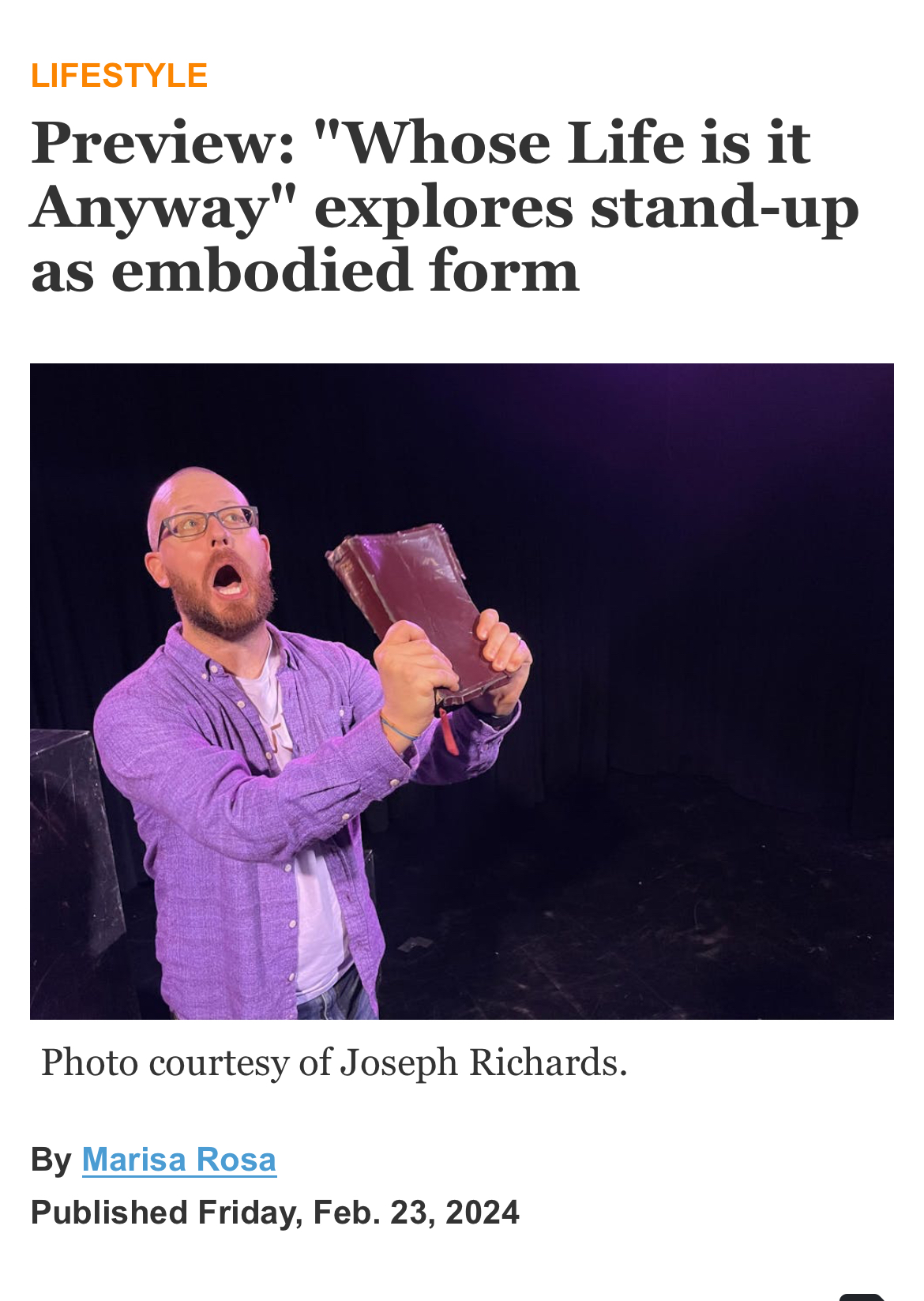
[Above: Article in The Daily Tar Heel about the show]
Stand-up comedy since 2013 appears to be addressing both new and old questions regarding who or what should be the butt of the joke. Canadian comic Mike Ward told jokes about disabled Canadian teenager Jérémy Gabriel and ended up in front of the Canadian Supreme Court. Muslim Indian comic Munawar Faruqui was jailed by Hindu nationalists after past jokes about Hinduism. Australian comic Hannah Gadsby argued that jokes did not let her tell her story properly by freezing a traumatic moment into a comedy bit. One issue connecting all of these moments is a concern with how the embodied performance of stand-up comedy affects material bodies on and off stage. In other words, a question for contemporary performance and comedy studies is, what happens when bodies appear on stage, in the folds of re-enactment, in the form of a joke? Or to put it another way, how can a focus on the repeated, re-iterated, and re-enacted body of another help us understand the relationship between stand-up comedic performance and the political-social contemporary moment?

[Above: Official event poster]
In this interactive 30-minute stand-up comedy performance, I explore the processes and effects of summoning an “absent” body on stage in the form of a joke, thus shaping that body in the process. To interrogate these processes, I perform devised and improvised series of vignettes and prompts for and with the live audience. The bits reveal how and what happens when comics pull certain bodies on stage in the form of jokes, whether or not those bodies are in the audience at the time and regardless of if those bodies wish to appear on stage.

[Above: Photo of the black box performance space set up pre-show]
As Lauren Berlant and Sianne Ngai note, “Comedy helps us test or figure out what it means to say ‘us.’ Always crossing lines, it helps us figure out what lines we desire or can bear” (2017, p. 235). This performance interrogates just what lines we can bear and how we can create belonging or unbelonging in the ways in which we shape comedy bodies through our jokes and through our laughter.

[Above: Anonymous audience member feedback following the performance]
 The Joseph Richards Show